Monday, March 6, 2023

Find your story and write a memoir

Nature writing is often also first-person writing.  Is your memoir also nature writing? Maybe/maybe not. Find your story with a free guided workbook.  FirstPersonWriting.com @amyloujenkins

Friday, February 3, 2023

Braiding Sweetgrass Video and link to Book Review

Wisdom, gathered for you.

“I am the woman with the basket” Kimmerer declares after an immersive walk into the woods searching for leeks, “and how I fill it is the question that matters.  If we are fully awake, a moral question arises as we extinguish the other lives around us on behalf of our own”(p.179).  In this essay, ‘The Honorable Harvest’, the elders, the Earth, cultures, hunters,  animals, and plants pass their wisdom through a judicious and compassionate writer to woo the reader to become a better version of themselves. 
 Read full review at https://amyloujenkins.com/braiding-sweetgrass-book-review/  

Saturday, December 31, 2022

Book Review: 'The Home Place Memoirs of a Colored Man’s Love Affair with Nature'


Click here to follow an
 affiliate link to Amazon

Purchases may result in
 a small payment
 to the site owner at no cost to you.

In his debut memoir, self-described “eco-addict” J. Drew Lanham explores the connection between trees and family trees, birds and brethren, and most importantly of all, the place where mother nature and human nature meet. Taken together, it makes for a unique reading experience; one in which the book’s meditative qualities far surpass any semblance of a conventional plot. Let the reader be warned, there are no fireworks here—simply the musings of an African-American naturalist who, throughout his lifetime, has trained himself to marvel at the minor. Trust me, that is enough.

"In me, there is the red of miry clay, the brown of spring floods, the gold of ripening tobacco. All of these hues are me; I am, in the deepest sense, colored.” From these fertile soils of love, land, identity, family, and race emerges The Home Place, a big-hearted, unforgettable memoir by ornithologist and professor of ecology J. Drew Lanham.


Read more: AmyLouJenkins.com


Friday, December 23, 2022

Going Native with the Red Buckeye

Plant from my first Buckeye seed


The red buckeye (Aesculus pavia) delights nature lovers. People love them for their striking foliage and blooms. Is it a tree or a shrub?  The answer lies in the conditions the plant grows in. In rich soil and sunshine, it’s likely to become a small tree, growing over 15 feet tall. In poorer soil or shadier conditions, it’s likely to be more shrub-like. The stunning, bright red flowers bloom in late spring. Planting this buckeye in your yard offers a wide range of benefits including improved soil fertility, increased wildlife activity, as well as providing habitat nectar for pollinators. Like most native plants, this lovely shrub has a relationship with its landscape. There are many reasons to plant and nurture the red buckeye, sometimes called scarlet buckeye, in your garden.

The lovey buckeye trees are considered toxic to humans and animals if ingested. While dogs don’t tend to find it enticing, some pets will eat anything. If your pet chews on objects that are not obviously food;


 supervise them around your landscape, or consider not adding this tree to your yard. As for kids, tell them the tree and seeds are toxic. Keep little ones away from danger.

The red buckeye is a deciduous shrub/tree that blooms in mid-spring. It's a hardy plant in Zones 4b to 8.  With waxy green leaves and clusters of bright red flowers, it grows best in full to partial sun and can thrive in acidic and alkaline soils. The red buckeye gets its name from the seeds that resemble the eye of a deer.

I look to the shrub in spring for its first flush of growth, fast-growing spikes of palmate leaves, and the flower buds that draw the season’s first pollinators and hummingbirds.  Read more 

Tuesday, September 28, 2021

Food Security and Water Safety


The World Wildlife Fund announces the results of a new study that links food security to intact and safe water biotas. 


  • A new analysis finds that irrigation with river water accounts for 25% of all food. And 40% of global fish consumption depends on rivers
  • One group that knows how to combat this issue may work in your backyard.  They probably need your help. Find or start a WaterKeeper Alliance group in your community.

Waterkeeper Alliance

Waterkeeper Alliance holds polluters accountable. They are the largest and fastest-growing nonprofit solely focused on clean water. They preserve and protect water by connecting and mobilizing more than 300 local Waterkeeper groups worldwide. Waterkeeper states their goal is "drinkable, fishable, swimmable water everywhere." And water is essential to food security. As a result, supporting the Waterkeeper Alliance is one of the best ways to be a part of water and food advocacy in your community.  Read More, find your local Waterkeeper, and find the link to free Waterkeeper Magazine. 

Friday, September 3, 2021

Stronger Hong Kong Illegal Wildlife Smuggling Legislation: Too Little, Too Late?

 
Under a new 2021 bill passed by The Legislative Council of Hong, illegal trade offenses can now be investigated and charged under the Organized and Serious Crimes Ordinances ( OSCO).

Will the enhanced ability to charge and prosecute actually combat illegal wildlife trade?  The World Wildlife Fund (WWF)  says they formerly  “welcome the legislation.” Still, it isn’t clear if the new bill will make a difference.   

Jovy Chan, Manager, Wildlife Conservation, WWF-Hong Kong, said “The volume of illegal wildlife trade in Hong Kong remains high. However, internationally significant cases have not been pursued by Hong Kong prosecutors owing to the insufficiency of evidence.”

Hong Kong’s record pangolin seizure of 8.3 tons seized, along with 2.1 tons of ivory in 2019 remains unprosecuted because of the lack of evidence. Within the three years between 2018 and 2020, local enforcement authorities seized over 929 tons of wildlife valued at over HK $358 million. 

Pangolins are believed to be the world's most trafficked mammal, accounting for as much as 20% of all illegal wildlife trade


“Hong Kong is a major transit hub for the illegal wildlife trade. Traffickers exploit the Hong Kong Ports for continuous trade of the world’s most endangered species of wild fauna and flora. The volume of trade is on the rise, contributing to the global extinction crisis," added Chan.

The WWF reported in 2020 a two-thirds decline in wildlife populations on average since 1970. Since declines are not consistent across all species, biodiversity suffers. Protecting illegal trade could make a difference in protecting traded species. 

When consumers find illegal wildlife products for sale, they can use the WWF  online reporting tool at endwildlifetraffickingonline.org.  

Sources:

www.endwildlifetraffickingonline.org

www.worldwildlife.org/press-releases/hong-kong-officially-includes-illegal-wildlife-trade-in-organized-and-serious-crimes-ordinance-to-better-curb-smuggling-activities

Monday, October 19, 2020

Poachers of Flying Squirrels Caught

Flying squirrels do not make good pets.


Today the Florida Fish and Wildlife Conservation Commission announced they have uncovered a transnational wildlife trafficking operation in Florida and that multiple arrests have been made. The crime involves poachers setting squirrel traps throughout Florida and capturing 3,600 flying squirrels who were exported to Asia through a trail by way of Chicago, Atlanta, and ultimately to South Korea, according to FFWCC.  

In learning of this news, Kate MacFall, Humane Society of the United States Florida senior state director, released the following statement: 


“Congratulations to the Florida Fish and Wildlife Conservation Commission for uncovering the poachers who captured as many as 3,600 flying squirrels in central Florida to sell internationally in the pet trade. The public’s desire to keep wild animals as pets contributes to an industry plagued with cruelties. In both the legal and illegal wildlife trade, countless wild animals suffer greatly or die due to negligent treatment in the process of capture, at crowded breeder and dealer facilities, in transport, and ultimately possession by families who eventually become overwhelmed by the specialized level of care required. While FWC cracks down on poachers, we urge the public to choose dogs and cats as pets, not wild animals.”

Ad: Howie Tootalot teaches a laugh-filled and important lesson about interacting with wildlife. Gift your kids laughs and lessons with Howie Tootalot in Yellowstone. 


Tuesday, April 3, 2018

Beef and butterflies


Photo courtesy of Environmental Defense Fund

Austin-area ranchers

 and conservationists

show beef and butterflies 

can thrive together


(AUSTIN, TX – April 3, 2018) The Texas Farmers’ Market and Environmental Defense Fund are co-hosting a Monarch Festival in Austin, Texas this weekend to educate visitors about the Monarch Butterfly Habitat Exchange, a new program for restoring and conserving high-quality monarch habitat on America’s private working lands. The exchange launched on March 1, 2018 with its first five projects located in Texas.
Amy and George Greer, sixth generation ranchers at Winters Family Beef located in Brady, Texas, are early participants in the exchange and sell their Angus and Wagyu beef every weekend at the Texas Farmers’ Market. The Greers and monarch experts from Environmental Defense Fund will be available for interviews.
Market visitors can stop by the main market tent to enjoy a variety of monarch butterfly activities, including monarch butterfly face painting and butterfly wing balloons from Tony the Clown. The first 15 shoppers who sign up for Texas Farmers’ Market weekly newsletter will receive a milkweed start from f-stop farm to grow monarch habitat.
Where:
Saturday, April 7 at Lakeline, 10 a.m. – 12 p.m., 11200 Lakeline Mall Drive, Cedar Park, Texas 78613
Sunday, April 8 at Mueller, 11 a.m. – 1 p.m., 4209 Airport Blvd., Austin, Texas 78722
Who:
  • Amy and George Greer, sixth generation ranchers at Winters Family Beef
  • David Wolfe, director of conservation strategies at Environmental Defense Fund
Kids love nature


Wednesday, March 28, 2018

Literary nonfiction: promising


We know that prescriptive non-fiction can be a big seller.  So “ten awesome ways to channel change for a successful life” might be the kind of change book that can be monetized by key words and targeted selling. That kind of book would offer a specific path, not a personal one.  You wouldn’t own that path. 

http://www.jackwalkerpress.com/the-subtle-and-big-promise-of-literary-nonfiction/

Wednesday, August 16, 2017

Love, Love 'Lab Girl' by Hope Jahren

Buy 'Lab Girl'
‘Lab Girl,’ by Hope Jahren, Vintage, paperback-2017, 282 pages.     One might imagine that no one really needs an autobiography from a bipolar plant geobiologist: one would be mistaken. Hope Jahren’s memoir begins in her father’s lab and continues with a stoic walk in small town Minnesota. As her foot hits the icy pavement, a world appears. With each step, the town, a loving yet emotionally stifled family, Scandinavian paradigms, her past, and the portent of the future appear in multidimensional authenticity. The world she builds is tangible, funny, and troublesome. She writes about fallen leaves: “These brave trees lay all their earthly treasures on the soil, where moth and rust doth immediately corrupt. They know better than all the saints and martyrs put together exactly how to store next year’s treasure in Heaven, where the heart shall be also.” She shares difficult details about dysfunctional head-banging, rejection, snotty crying, and failures that lead to breakthroughs. She writes of poverty, family, love, victory, and plants. Her stories of plant wonders always do double duty as metaphors for humanity.   Read the full review at the JackWalkerPress blog :Dispatches from AL.   And remember that kids need nature too.  Explore the fun of the Tootalot series from Jack Walker Press. 

Monday, August 14, 2017

Row your way to better health and enjoy the journey

Buy from $2.99
Health Benefits of Rowing
Find an exercise you like and you are likely to improve your quality of life as well as your lifespan. If you love rowing, you are lucky because rowing tends to be high in benefits and low in joint impact and injuries. The benefits are so significant that this is a sport you should try if you have access to equipment and a place to row. Using a rowing machine (ergometer) is becoming a hot new sport. Some say the rowing is the new spinning—but rowing is even better and provides a more balanced full-body workout. If you love the water and nature, gliding across a lake or river or even calm ocean waters can be both calming and motivating. Once the technique of rowing becomes habit, the movements can build power and strength to your cardiovascular system and muscle groups.
 Get rid of extra fat
Rowing is predominately an aerobic sport. According to fitness trainer Aamir Becic, most rowers can easily burn up to 600 calories an hour, while competitive rowers expend almost twice the number of calories on a 2,000-meter course as a runner in a 3,000-meter steeplechase. Rowing can promote a healthy balance of fat to muscle in disciplined rowers.
Tone everywhere
Rowing, when done correctly, works the back, hamstrings, gluteal muscles, biceps, and core. It utilizes more body parts than most cardiovascular gym equipment. People of many different fitness levels can approach the sport. Rowing just might be the most efficient exercise ever. “With each stroke, pretty much every part of the body is used,” says Stella Lucia Volpe, an exercise physiologist and professor of nutrition sciences at Drexel University in Philadelphia and an avid rower. And it may let you skip crunches—for good. “A big part of rowing is core strength,” she adds. “People think it’s all arms, but rowing is much more legs and core.”
As quadriceps become stronger, activities and exercises such as walking, jogging, lunges and squats can be done more efficiently.
More health benefits are explained in Single Scull Rowing for Beginners. 

Friday, July 28, 2017

World Wildlife Fund and Walmart join forces.

While Walmart doesn't srping to mind when considering conservation, they are a  company that is so big, that their efforts may have big effect.  World Wildlife Fund (WWF), the Foundation for Food and Agriculture Research (FFAR), and the Walmart Foundation today announced a research program to maximize crop utilization and edible food recovery. With two grants from FFAR and the Walmart Foundation totaling $1.3 million, WWF will work with research teams across the country including University of California, Davis and the Global Cold Chain Alliance to identify practical opportunities for producers to increase the proportion of crops that are harvested and delivered to the highest value destinations.
Of the estimated 63 million tons of food lost or wasted annually in the U.S., more than 80% is lost or wasted in consumer-facing businesses and in homes. While it’s estimated that less food is lost on farms, the lack of data quantifying this loss in different crops makes it difficult to validate estimates, identify drivers and define cost-effective solutions. Over the next 22 months, research teams aim to bridge those data gaps and test interventions to maximize crop utilization and profitability on farms.
 “Our nation’s producers work hard every harvest to provide food, fuel, and fiber to our economy, but they don’t always see the same return on investment,” said Sally Rockey, Ph.D., FFAR Executive Director. “This on-farm research will uncover opportunities for growers to do more with the same resources. I look forward to practical results that will bolster bottom lines for farmers and deliver more nutritious food to dinner tables.” 
As part of the first phase of the program, researchers at University of California, Davis (UC Davis) are working with farmers to gather their input on strategies and opportunities for maximizing crop harvest and use. Their research is focusing on leafy greens, peaches, and tomatoes. UC Davis will also quantify the environmental impacts from seed to harvest for each of these crops. A team led by the Global Cold Chain Alliance will collect qualitative and quantitative data and organize field studies to estimate on-farm and postharvest losses, and identify the current destinations of produce that never makes it to someone’s dinner plate or another end use. Initial research will focus on the harvesting of potatoes in Idaho and Eastern Oregon, tomatoes in Florida, romaine lettuce in Arizona, and peaches in New Jersey.
“The best way to feed people without putting more stress on our environment is to increase the availability of food that has already been produced,” said Jason Clay, WWF’s senior vice president of markets and food. “Each bite that doesn’t reach consumers represents a loss of the natural resources—and money—used to produce it. We’re grateful to the Foundation for Food and Agriculture Research and Walmart Foundation for supporting research that can help promote more efficient use of land, water, energy, and natural resources, and deliver more crops to the highest value destinations.”
Researchers will use well-established systems—such as the Community System Assessment Methodology, Life Cycle Assessment, and World Resource Institute’s Food Loss and Waste Standard—to ensure consistent reporting across different in-field and supply chain measurement methods, and to facilitate collaborative research and interventions. The project aims to collaborate with other farm-level research projects and pilots within the food rescue community.
“We’re proud to support this research to find ways to deliver more crops from field to plate,” said Eileen Hyde, director for Walmart Giving. “This program aligns with the Walmart Foundation’s philanthropic work to address gaps in the food system upstream to prevent food waste.”
ABOUT WWF
WWF is one of the world’s leading conservation organizations, working in 100 countries for over half a century. With the support of almost 5 million members worldwide, WWF is dedicated to delivering science-based solutions to preserve the diversity and abundance of life on Earth, halt the degradation of the environment and combat climate change. Visit www.worldwildlife.org to learn more and keep up with the latest conservation news by following @WWFNews on Twitter.
ABOUT THE FOUNDATION FOR FOOD AND AGRICULTURE RESEARCH
The Foundation for Food and Agriculture Research, a 501 (c) (3) nonprofit organization established by bipartisan congressional support in the 2014 Farm Bill, builds unique partnerships to support innovative and actionable science addressing today’s food and agriculture challenges.  FFAR leverages public and private resources to increase the scientific and technological research, innovation, and partnerships critical to enhancing sustainable production of nutritious food for a growing global population. The FFAR Board of Directors is chaired by Mississippi State University President Mark Keenum and includes ex officio representation from the U.S. Department of Agriculture and National Science Foundation.
--Published on this site by Amy Lou Jenkins

Friday, June 23, 2017

Duck Stamps: Get your Duck Stamps

The new Federal and Junior Duck Stamps go on sale today.  -- a day that some hunters, birders, conservationists and stamp collectors look forward to every year. Born in the dust bowl days, the Duck Stamp was created in 1934 to protect wetlands that are vital to the survival of migratory waterfowl.  Since that first stamp, sales have raised more than $950 million to help clean water, enhance outdoor recreation opportunities and more.


According to the Department of the Interior: "These stamps are part of the waterfowl hunting license requirements and every hunter over the age of 16 must purchase and carry with them a Duck Stamp each year in order to hunt ducks, geese and other waterfowl. But they are also collectible works of art and the easiest way for anyone to support bird habitat conservation with 98 percent of the proceeds going to the Migratory Bird Conservation Fund."

J.N. (Ding) Darling sketched our first duck stamp, and now artists compete to win the art contest. The Duck Stamp program is part of a system that works to preserve waterfowl while allowing for some regulated hunting.  

Monday, June 5, 2017

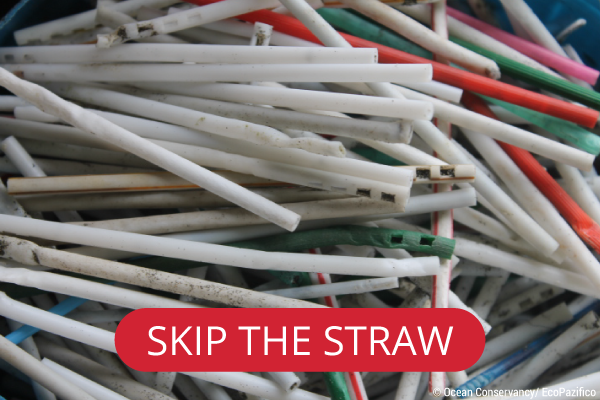
Easy action for good: Skip the straw

Marine debris is a massive problem in our ocean. So big, it can feel overwhelming (trust me, I know!). But the good news is that you and I can help stem the tide of trash entering our ocean, by making simple changes in our day-to-day lives.
One of the easiest ways to combat plastic pollution? Skip the straw.
At last year’s International Coastal Cleanup, volunteers picked up hundreds of thousands of straws and stirrers, making straws one of the top ten items found—sadly this is true year after year. Straws are eaten by sea turtles and seabirds, and have even been discovered stuck in the nares (nostrils) of turtles.
Take action to help the ocean today. Text “straw” to 91990 and pledge to Skip the Straw next time you go out to eat!
Together 25,000 people can save 5 million plastic straws from entering the ocean and filling the landfills in just one year.
Straws are one of the most easily preventable pieces of marine trash. Next time you’re at a restaurant, just ask the server to “Skip the Straw”, and encourage your friends to do the same! And if you really can’t enjoy your drink without it, try one of the many reusable or biodegradable straws out there.
It couldn’t be easier! Text “straw” to 91990 to take the pledge.
Marine debris may be an overwhelming problem, but together we can make a BIG difference.
Pledge to Skip the Straw today and text “straw” to 91990! The ocean, and the animals who rely on it, will thank you.

Monday, May 1, 2017

Whimsical wool sower wasp

Pink polka dots and wasps were not an iconic pairing in my mind, but springs walks never fail to deliver awesomeness. My  sister and I discovered these polka dot balls on an April walk in a oak pine forest. We had no idea we were admiring wasp handiwork. If a duck quacks, a flower blazes, or a bud emerges—I’m likely to stop and appreciate.  Butterflies, dragonflies, and caterpillars halt me, but wasps and flies tend not to engage me. Like many women, I don’t love bugs. My sister and I have been known to run-away, and we love our husbands more when they “save us” from spiders and six and eight-legged home invaders. 
Walnut-sized, Dr. Seuss inspired pink polka dot balls on white oaks do make me stop in wonder.  My sister and I hovered over them. We prodded them with a stick and walked away scratching our heads. Had we dissected one, we would have found what looked like little seeds, but were in actuality small larvae of the Wool sower wasp (Callirhytis seminator).
These parasitic wasps have co-evolved with the oak so that when the wasps lay their eggs on the deciduous tree in the winter, the eggs and trees respond to spring together. When the eggs hatch, the grub’s secretions stimulate the plant to develop gall tissue. The gall protects and feeds the developing larvae and we get polka dot balls on oak trees.
My prejudice against insects has perhaps diminished (but stay out of my house–and don’t take up residence in my sister’s house either.) a bit.  John Muir said that whatever we expect from a nature “we always get more.” I’m finding that this maxim even holds true for insects.    The wool sower wasp doesn’t sting, which is true of most wasps. 
Take children outdoors and buy them books about nature. Consider this one

Howie Tootalot in Yellowstone: The Legend of Lake Isa (The Tootalots) (Volume 2) Paperback

Why does the water of Isa Lake drain in two different directions? Follow Howie Tootalot to the wild land we now call Yellowstone as he and his new bear friend explore the wild geysers, waterfalls, lakes, rivers and more. Danger surrounds them, yet lessons from the wild and the wilderness itself will save them. Learn the Tootalot family legend. Children may download and assemble their own free puppets—just like the ones in the story. Great fun for reading and play at home or in the car. Howie Tootalot in Yellowstone is the second in The Tootalots series. Award-winning parenting author, dons a pen name and introduces Howie Tootalot in this fun legend that offers giggles and some important ways to deal with respecting the danger and wildness of natural wonders such as Yellowstone National Park.

Thursday, March 23, 2017

Call for submissions

 I recently returned to our Arkansas cottage after a quick road trip to see Manatees in Florida. On a dark, cold Jan. morning I walked to Manatee Springs from our campsite to find four manatees in shallow water. They were warming themselves in the relative warmth of the springs. Baby hugged mom. Mom nudged her calf to the surface every 5-10 minutes. Two other manatees seemed to be positioned to protect the duo. In the morning light I could see their massive curvy bodies and they loved and breathed. I watched for a hour, and the rhythm of their respiration calmed my nervous head and heart. That was their lesson to me: love and breathe. Those actions are not passive.
We have all processed many feelings in the last few months. Ready to write? Jack Walker Press themed anthologies are ready to partner with you and respected organizations to deliver artful personal essays and do the important work of art.
Our first collection will explore the theme of transitions. The essay need only be loosely connected to the theme in whatever way you see the connections. We will partner with the University of Wisconsin Madison and assemble and promote this collection during the Write By the Lake class in June. Learn more at http://continuingstudies.wisc.edu/…/…/sessions-speakers.html You do not need to take the Madison class to submit to the anthology. Submit by June, 15, 2017--the earlier the better!
Our second anthology will explore the theme of exclusion and the other. This theme seems even more pertinent to today's political climate than when we selected it last summer. The essays don't have to be political. Marian Fredal and other activists and writers have agreed to participate in the editorial selections for this collection. Profits will be donated to the Southern Poverty Law Center or a similar charity. Submit by Dec. 31, 2017,
Submit through Green Submissions; you will need to register there first (free). https://greensubmissions.com/723/the-xyzs/index.php
On a personal note, I am seeking reviewers for the first two volumes of a children's book series. If you have kids or love kids literature (picture book for early readers--seven or eight and under--let me know via email if you would like a review copies and will post honest reviews on Amazon.
Thanks for reading, and don't you have some writing to do? Let's get our voices out there!
With love and admiration in anticipation of your thoughtful work,
Amy Lou
Amy Lou Jenkins
Award-winning author Every Natural Fact

AL@JackWalkerPress.com

Saturday, February 11, 2017

Monarch butterflies decline to historic low

 Overwintering monarch butterflies in Mexico have declined by 27%.  These historic lows may be related to declining habitat and increases in erratic weather.
 World Wildlife Fund (WWF) released the following statement from Omar Vidal, CEO of WWF in Mexico:
"The monarch migration is a phenomenon like no other. But now, it’s imperiled by forces the monarchs themselves cannot control. The reduction in the area of forest they occupied this year - most probably due to the high mortality caused by storms and cold weather last year - is a clear reminder for the three countries that they must step up actions to protect breeding, feeding and migratory habitat."
"We cannot control the climate, but we can do much better in eradicating illegal logging in the reserve and tackling habitat loss in the U.S. and Canada. But, even if Mexico's overwintering sites never lose another tree, without food and habitat along the migration routes the forests will soon bid farewell to their final orange and black-winged tenant."
Consumers can help butterflies by taking care to use wood and wood products from known sustainable sources, protect natural habitats, and to plant milkweed.  Many kinds of milkweed are well suited to home landscaping.  Gardeners should take care to avoid insecticides.   Gardeners who plant native milkweeds and then use insecticides kill monarchs. 

Saturday, December 24, 2016

163 new species discovered in in Cambodia, Laos, Myanmar, Thailand and Vietnam


Cool new species found. Klingon from the movie Star Trek is one of the 163 new species discovered recently in the Greater Mekong region, according to a report released today by World Wildlife Fund (WWF). The report, Species Oddity, documents the work of hundreds of scientists who discovered nine amphibians, 11 fish, 14 reptiles, 126 plants and three mammals in Cambodia, Laos, Myanmar, Thailand and Vietnam.

A rainbow-headed snake resembling David Bowie’s Ziggy Stardust character, a dragon-like lizard and a newt that looks like a
The discoveries also include a rare banana species from Thailand, a tiny frog from Cambodia and a gecko with pale blue spotted skin and piercing dark eyes that was found hiding among the remote mountains of Laos. This brings the total new species of plants, birds, mammals, reptiles, fish and amphibians discovered in the region to 2,409 since WWF began compiling new species reports in 1997.
“The Greater Mekong region is a magnet for the world’s conservation scientists because of the incredible diversity of species that continue to be discovered here,” said Jimmy Borah, Wildlife Programme Manager for WWF-Greater Mekong. “These scientists, the unsung heroes of conservation, know they are racing against time to ensure that these newly discovered species are protected.”
Highlights of the report include:
• A rainbow-headed snake, Parafimbrios lao, that has been likened to David Bowie’s Ziggy Stardust character. It was found among steep karst cliffs in Northern Laos and while originally thought to exist in only one location, it has since been seen in a second one, increasing its chances of survival.
• The Phuket Horned Tree Agamid, Acanthosaura phuketensis, has a fearsome set of horns on its head and spine and was found among the few remaining forest patches on the popular Thai tourist island of Phuket. It is threatened by rapid habitat loss and collection for the pet trade.
• A rare banana species discovered in Northern Thailand, Musa nanensis, is already considered critically endangered due to increasing deforestation and the fact that only a handful of individual plants have been seen. However, the recent discovery of another small population has given researchers hope for the species.
• A new frog species from Cambodia and Vietnam, Leptolalax isos, has a name that is about as long as its body. At 3 cm, this diminutive amphibian is threatened by some major forces – logging, agricultural expansion and hydroelectric projects.
• A newt discovered in Thailand’s Chiang Rai Province, Tylototriton anguliceps, has stunning red and black markings that resemble a Klingon from the movie Star Trek. Its porous skin makes it especially sensitive to pesticides, the main threat alongside deforestation of its habitat.
• A gecko discovered in the remote karst mountains of Laos by a team of scientists who often had to rely on water dripping off stalactites in caves. Gekko bonkowski i is believed the discovery may hold the key to understanding lizard evolution in the Annamite Mountain Range.
• A plant from the Chin Hills of North-western Myanmar that has two petal coverings (sepals) resembling mouse ears. Discovered on Mount Victoria, Impatiens kingdon-wardii is a reminder that Myanmar’s rich biodiversity needs protection as the country rapidly opens up to development.
• A bat, Murina kontumensis, found in the Central Highlands of Vietnam with thick and woolly fur on its head and forearms.
The Greater Mekong region is under intense development pressure from mines to roads to dams, threatening the survival of the natural landscapes that make it so unique. Poaching for bushmeat or the multi-billion dollar illegal wildlife trade puts additional pressure on the region’s wildlife, meaning many species could be lost before they are even discovered.
“Many collectors are willing to pay thousands of dollars or more for the rarest, most unique and most endangered species, often buying them at the region’s illegal wildlife markets, especially in the Golden Triangle region where China, Laos, Thailand and Myanmar meet,” Borah said. “To save them, it’s crucial that we improve enforcement against poaching and close illegal wildlife markets as well as the tiger and bear farms that openly flaunt wildlife laws.”
WWF recently launched an ambitious project to disrupt the trade by closing down the biggest markets in the Greater Mekong region. Working with partners and across borders, WWF will attempt to significantly reduce illegal trade in key threatened species such as elephants, tigers and rhinos by promoting species protection legislation, supporting effective transboundary cooperation and improving law enforcement effectiveness at key border crossings.
The full report can be seen at: http://www.panda.org/species_oddity

Find your story and write a memoir

Nature writing is often also first-person writing.  Is your memoir also nature writing? Maybe/maybe not. Find your story with a free guided ...